.png)

The Setup
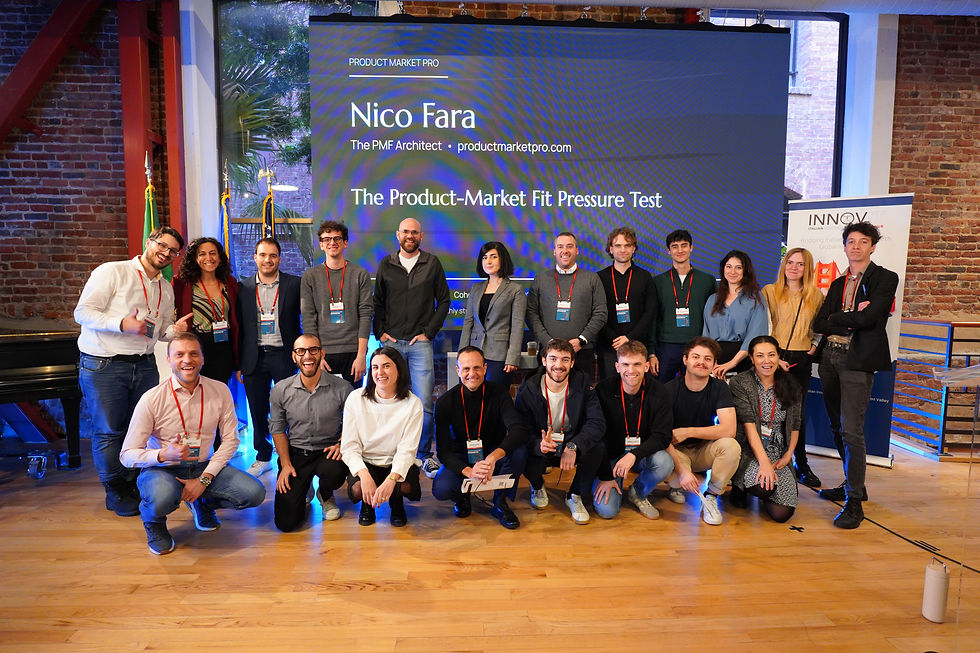
Fifteen Italian startups. Two days before Demo Day. Each team had traction in Europe, a product they believed in, and a pitch they’d rehearsed. What most did not have was an answer to the question that determines whether any of it compounds: Who, specifically, is buying this—and why would they buy it from you?
The INNOVIT Startup Bootcamp brings Italian deep tech and B2B companies to San Francisco to prepare for US market entry. Cohort 17 included companies spanning AI infrastructure, healthcare AI, fintech, climate tech, aerospace, fan engagement, HR technology, and industrial robotics. Most were pre-seed or seed stage. Several had paying customers in Italy. None had validated a US buyer.
Each founder sat down with a single-page diagnostic: The PMF Pressure Test. Eight questions. No multiple choice. No strategy frameworks. Just the raw decisions that determine whether growth compounds or fragments.
The Diagnostic
The PMF Pressure Test is designed to surface one thing: whether a company’s buyer decisions are strong enough to compound. Not whether the technology works. Not whether the market is large. Whether the specific choices a leadership team has made about who they serve, what problem they solve, and what they’re willing to deprioritize are coherent enough to create repeatable growth.
Founders filled out the worksheet individually. Then, in hot seat sessions, select founders defended their answers under diagnostic questioning—live, in front of the full cohort. The room heard each assumption tested. And something happened that the worksheets themselves recorded: founders who were never called to the hot seat began revising their own answers in real time, crossing out assumptions and rewriting them as they recognized the same gaps in their own thinking.

The Patterns
The worksheet asks founders to name their first buyer — not a market category, but a specific person they could actually find and sell to.
The majority of founders answered with a market category anyway. “Enterprise companies.” “CEOs.” “SMEs.” These are not buyers. They are populations. A buyer has a title, a budget, a problem they’re actively trying to solve, and a reason they would take a meeting this week. Only a handful of worksheets named someone specific enough to actually find.
This distinction matters because everything downstream depends on it. The pitch, the pricing, the feature roadmap, and the investor narrative all flow from a single commitment: this is who we serve first. Without that decision, every other decision is provisional.
The Category Buyer Trap
The worksheet pushes founders to quantify the cost of their buyer's status quo — not the value of their own solution. Most did the opposite. They quantified the value of their solution—not the cost of the status quo.
One team described how their platform could reduce costs by 40%. Another cited the efficiency gains of their AI model. A third referenced time savings. All of this describes what the solution provides. None of it describes what the buyer is losing today by not having it. The distinction matters: buyers do not pay for potential value. They pay to escape a problem they can already quantify. When a founder cannot articulate the cost of inaction in the buyer’s language, the sales conversation defaults to education—and education does not compound.
Quantifying the Solution Instead of the Problem
One question on the worksheet asks founders to name the most important decision they need to make in the next 90 days — not what to build, but what to decide.
This was the question that revealed the most. Several founders left it blank. Others wrote what they planned to build rather than what they needed to decide. Feature lists. Roadmap items. Product milestones. These are execution plans, not decisions.
A decision is a narrowing. Which vertical do we lead with? Which buyer do we serve first? Which use case do we say no to? The inability to name the decision is itself a diagnostic signal. It means the company is operating in build mode—adding options—rather than in focus mode—eliminating them. That is the structural condition under which growth cannot compound.
The Blank 90-Day Decision
Multiple founders had meaningful traction in Italy: paying customers, active pilots, revenue, established partnerships. But when asked to define their US buyer, many wrote a different persona entirely—or the same persona without evidence that the problem existed at the same intensity in the US market.
The pushback these founders reported hearing from US investors was consistent: “No US traction.” “No validation here.” “Not relevant in this market.” These are not objections to the technology. They are objections to the buyer thesis. European traction proves the product works. It does not prove that a specific US buyer has the same problem, at the same urgency, with the same willingness to pay.
European Traction ≠ US Buyer Thesis
What the Session Surfaced
The hot seat format works because it creates two kinds of pressure. The founder on the hot seat has to defend their assumptions out loud. Everyone else in the room has to watch and ask themselves: Would my answers hold up?
The worksheets recorded that second effect. Founders who were never directly questioned crossed out their original answers and rewrote them—narrowing an ICP from five verticals to one, reframing a 90-day plan from “build features” to “find one paying US customer,” rethinking whether a European exit strategy made sense before validating a single US buyer.
Two days is not enough to overhaul a pitch. Several founders said as much at Demo Day. But that was never the point. The PMF Pressure Test is not pitch coaching. It is a diagnostic that surfaces the decision a company has been avoiding. What founders do with that clarity—whether in two days or two months—is up to them. The ones who came back and said the session changed how they think about their buyer were clear-eyed about the difference: the discomfort was the value.
The Takeaway
Product-market fit is not a discovery. It is a decision.
Every company in Cohort 17 had a product worth building. Several had traction worth investing in. But traction alone does not compound. Growth compounds from commitment—the willingness to choose one buyer, one problem, one wedge, and build everything around that choice until the market either confirms or rejects it.
The PMF Pressure Test does not tell founders what to decide. It reveals that a decision needs to be made—and shows what happens when it hasn’t been. The patterns that surfaced in Cohort 17 are the same patterns that surface in every post-traction B2B company operating without focus architecture: broad ICPs, solution-first narratives, and an execution plan where the decision plan should be.
The exchange is simple. An hour of discomfort for the clarity to know what you need to decide next. That is why the test works.
About Facilitator
Nico Fara is the founder of Product Market Pro and works as the PMF Architect. Her practice helps technically complex companies turn early traction into compounding growth. The PMF Pressure Test is a live, compressed version of that practice: the same diagnostic work she does inside companies, run in a single high-stakes session.
About INNOVIT
The INNOVIT Italian Innovation and Culture Hub, based in San Francisco, operates the Startup Bootcamp program to accelerate Italian deep tech and B2B companies entering the US market. Approximately 30% of INNOVIT alumni companies have raised US capital within two to three years of completing the program.
Bring a Founder Working Session to your program
Give founders time to work through a business challenge they are actively facing, not just attend another presentation.
Sessions are tailored to the cohort's maturity, priorities and existing programming. Depending on the audience, the focus may be US market entry, commercialization, customer selection, pricing, launches or growth decisions.
We agree on the desired participant result, format, duration and preparation before developing the session.